If you’re performance-oriented, data-literate, and a little allergic to anything that sounds vaguely mystical, the phrase heart–brain coherence may trigger an eye roll. Fair.
So let’s strip this concept down to what it actually is: measurable nervous system efficiency.
Heart–brain coherence isn’t about emotions in the poetic sense, though it is also quite poetic. It’s actually about how effectively your autonomic nervous system coordinates information between the heart and brain—and how that coordination shows up in heart rate variability (HRV), cognitive performance, emotional regulation, and recovery capacity.
This is physiology, not philosophy.
The Heart Really Does Have Its Own “Brain”
The heart contains an intrinsic nervous system of approximately 40,000 neurons, sometimes referred to as the cardiac nervous system. These neurons allow the heart to sense, process, and respond to information independently of conscious control.
Communication between the heart and brain is bidirectional, but notably asymmetric:
- More neural information travels from the heart to the brain than the reverse
- These signals influence:
- Emotional processing
- Attention and decision-making
- Stress reactivity
- Executive function
This explains why insight alone often fails under pressure. The limitation isn’t intelligence or motivation—it’s signal quality.
What Heart–Brain Coherence Actually Means
Heart–brain coherence refers to a synchronized physiological state in which multiple systems align:
- Heart rhythm patterns
- Respiratory cycles
- Blood pressure rhythms
- Autonomic nervous system signaling
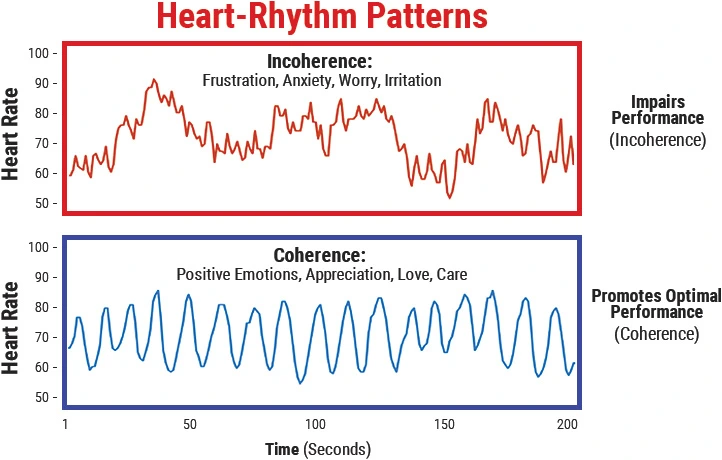
In coherent states, heart rhythms become smooth and predictable rather than erratic. This consistency reduces neural noise and metabolic demand, allowing the brain to function more efficiently.
Importantly, coherence is measurable through HRV biofeedback.
When coherence is low:
- HRV appears chaotic
- Cognitive performance degrades
- Emotional reactivity increases
- Recovery slows
When coherence is high:
- HRV shows rhythmic, sine-wave-like patterns
- Reaction time improves
- Emotional regulation stabilizes
- Less energy is spent on basic self-regulation
For high performers, that efficiency difference compounds quickly.
HRV: The Metric That Predicts Performance and Recovery
Heart rate variability isn’t about having a slow or fast heart rate. It reflects adaptive flexibility—the nervous system’s ability to respond to changing demands and return to baseline.
Higher HRV is associated with:
- Faster stress recovery
- Greater parasympathetic activation
- Improved cognitive flexibility
- Reduced burnout risk
In practical terms, HRV answers one critical question: How quickly can your system shift states without breaking down?
This is why HRV biofeedback is increasingly used in elite athletics, executive performance, and high-stakes environments—not as wellness branding, but as systems diagnostics.
Emotional Regulation Is a Physiological Skill
One of the biggest misconceptions in performance culture is that emotional regulation is a personality trait or mindset issue.
In reality, emotional instability often reflects inefficient autonomic signaling.
When heart–brain communication is disrupted:
- Threat detection becomes overactive
- Emotional responses lag behind context
- Cognitive strategies fail under load
Coherence doesn’t eliminate emotion. It improves signal resolution, allowing emotion to move through the system without hijacking it.
That’s why physiology-based emotional regulation techniques consistently outperform purely cognitive strategies under stress.
Why Float Therapy Supports Coherence So Effectively
Floatation REST removes nearly all external sensory input:
- No gravitational compression
- Minimal auditory or visual processing
- Reduced proprioceptive demand
With external noise removed, the nervous system can recalibrate internally. This reliably produces:
- Parasympathetic dominance
- HRV stabilization
- Accelerated recovery states
For performance-driven nervous systems that rarely downshift voluntarily, float therapy creates effortless coherence—not through discipline, but through environmental design.
When paired with HRV metrics, floating becomes a measurable recovery intervention rather than a subjective relaxation experience.
The Bottom Line (Without the Woo)
Heart–brain coherence isn’t about calmness. It’s about resilience and efficiency.
It’s the difference between:
- Forcing focus vs. sustaining it
- Managing stress vs. recovering from it
- Pushing harder vs. optimizing internal signaling
If performance, recovery, and long-term nervous system resilience matter to you, coherence isn’t optional—it’s foundational.
And the heart isn’t sentimental about it. It’s precise.